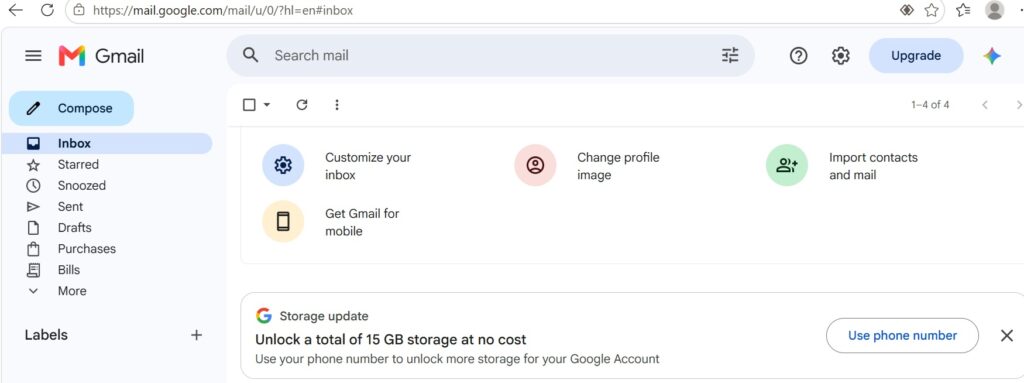
.Use your phone number to unlock more storage for your Google Account.
Google’s email and cloud storage services are under scrutiny following reports of a trial policy that reduces free storage capacity for new users.
While accounts previously received an automatic 15 GB of shared storage for Gmail, Google Drive, and Google Photos, some new users are now reportedly receiving an initial capacity of only 5 GB.
This policy has drawn global attention, particularly because users must verify a phone number to restore their storage capacity to the standard 15 GB.
Amid growing concerns regarding digital privacy, this change has raised questions about personal data security and the rationale behind the new policy.
Google Tests New Free Storage Capacity
Reports regarding this change first emerged from user complaints noting that their new accounts provided only 5 GB of capacity.
To regain the full 15 GB of storage, users are required to add and verify a phone number on their account.
The change is notable because, for years, Google has provided 15 GB of free storage shared across three core services: Gmail, Google Drive, and Google Photos.
Adjustments have also been observed in Google’s internal help documentation; phrasing that previously stated users received “15 GB of storage” has been updated to “up to 15 GB of storage.”
This shift is viewed as an indication that free storage is no longer guaranteed but is instead contingent upon specific conditions.
Google’s Reasons for Reducing Capacity to 5 GB
According to the company’s internal explanation, this reduction in initial capacity aims to maintain service quality while tightening security within the digital ecosystem.
A primary objective of the policy is to curb mass account abuse. Spammers and cyber-fraudsters have frequently created multiple new accounts to obtain additional free storage space.
Through the phone number verification system, Google aims to ensure that any additional capacity is utilized by genuine users.
This move also aligns with the company’s business strategy, which increasingly focuses on artificial intelligence (AI) development, strengthening subscription-based services, and expanding the Google One ecosystem. For context, Gmail first launched in 2004 with a revolutionary 1 GB capacity. Over time, that capacity increased to 2 GB, 7 GB, and 10 GB, before finally being consolidated into a shared 15 GB allowance across Gmail, Drive, and Photos in 2013.
“We are testing a new storage policy for new accounts created in specific regions to help us continue providing high-quality storage services to users, while also encouraging them to improve account security and data recovery,” Google stated, as reported by Android Authority on Tuesday (May 19, 2026).
This statement indicates that the new policy is not merely a storage limit but also part of a broader strategy for account security and recovery.
Limited Trial; Existing Accounts Remain Unaffected
Existing users need not worry about this change yet. Google has confirmed that the policy currently applies only to new accounts created in specific regions.
User reports indicate that the reduction in capacity to 5 GB has primarily been observed in accounts registered in several African countries.
To date, Google has not specified which countries are included in the testing phase or whether the policy will eventually be expanded to other regions.
This means that existing users of Gmail and other Google services can continue to enjoy the standard 15 GB capacity. Account holders who have linked a phone number have not reported any reduction in storage space.

How Safe Is It to Add a Mobile Number to a Google Account?
The requirement to add a mobile number has sparked debate regarding digital privacy. From a security standpoint, however, phone numbers serve a vital function.
Mobile number verification facilitates account recovery if a user forgets their password, loses access, or falls victim to hacking.
Furthermore, the system enables Google to verify identities more easily, preventing the abuse of additional storage capacity through the creation of multiple accounts.
On the other hand, storing a phone number does carry privacy implications. If an account were to be compromised, the linked number could potentially increase the risk of personal information exposure. Threats such as doxxing, identity theft, and data misuse are among the issues that require attention. Therefore, cybersecurity experts advise users not to rely solely on phone number verification.
Activating multi-factor authentication (MFA)—or two-factor authentication—remains a highly recommended additional layer of protection.
A trial offering 5 GB of free capacity—which can be boosted to 15 GB via phone number verification—reflects a shift in Google’s strategy for managing its digital ecosystem.
This move aims not only to curb spam accounts and the abuse of free storage but also to strengthen security systems and user data recovery capabilities.
In general, linking a mobile number to a Google account remains safe, provided users employ additional safeguards such as two-factor authentication, keep verification codes confidential, and regularly monitor account activity.
For now, the policy is in a limited trial phase. However, if rolled out globally, this change could represent one of the most significant transformations to Google’s free storage services since the integration of Gmail, Drive, and Photos over a decade ago.